1. The Global Automotive Batteries Landscape & Procurement Paradigm Shift
The global market for Automotive Batteries is undergoing unprecedented technological diversification. Driven by increasing vehicle electrification, advanced driver-assistance systems (ADAS), complex infotainment networks, and stringent global carbon emissions standards, the humble car battery has evolved from a basic Starting, Lighting, and Ignition (SLI) unit into a highly engineered energy storage system. For international procurement specialists, wholesale distributors, and fleet purchasing officers, navigating this shifting terrain requires deep technical comprehension of cell chemistry, structural grid design, thermal endurance, and standards alignment.
Traditional flooded lead-acid batteries remain the volume baseline in emerging markets, but modern vehicle architectures demand superior charge acceptance and deep-cycling capabilities. Absorbed Glass Mat (AGM) and Enhanced Flooded Batteries (EFB) have transitioned from luxury vehicle options to standard OEM equipment across micro-hybrid and start-stop vehicle fleets. Furthermore, 12V and 48V Lithium Iron Phosphate ($\text{LiFePO}_4$ or LFP) auxiliary batteries are rapidly capturing market share in premium ICE, hybrid, and full electric vehicle (EV) platforms due to their lightweight design and high cycle durability.
Key Information Gain Metric: Battery Chemistry Technical Benchmark
When evaluating large-scale procurement contracts for Automotive Batteries, purchasing departments must look beyond basic amp-hour rating ($Ah$) to evaluate cycle life depth, dynamic charge acceptance (DCA), and reserve capacity under extreme environmental stress.
| Battery Chemistry Type | Cold Cranking Amps (CCA Range) | Cycle Life (50% DOD) | Dynamic Charge Acceptance (DCA) | Thermal Resistance Range | Ideal OEM & Fleet Application |
|---|---|---|---|---|---|
| Standard Flooded (SLI) | 350A – 800A | 200 – 350 Cycles | Low ($\le 0.2\,\text{A/Ah}$) | -18°C to +50°C | Conventional ICE Vehicles without Start-Stop Systems |
| Enhanced Flooded (EFB) | 500A – 850A | 500 – 800 Cycles | Moderate ($\approx 0.4\,\text{A/Ah}$) | -25°C to +60°C | Entry-Level Start-Stop & Urban Delivery Fleets |
| Absorbed Glass Mat (AGM) | 600A – 1050A | 1,200 – 1,500 Cycles | High ($\ge 0.8\,\text{A/Ah}$) | -40°C to +65°C | Advanced Start-Stop, Heavy Electrical Loads & ADAS |
| Lithium Iron Phosphate (LFP 12V) | 700A – 1200A | 3,000 – 5,000 Cycles | Ultra-High ($\ge 2.0\,\text{A/Ah}$) | -20°C to +60°C (with internal heater) | EV Auxiliary Systems, Hybrid Dual-Battery & Racing Fleets |
As global supply chains face scrutiny under corporate sustainability mandates and trade policy adjustments, buyers must establish multi-tiered verification protocols for battery suppliers. Assessing grid alloy composition—such as Calcium-Calcium ($\text{Ca/Ca}$), Silver-Calcium ($\text{Ag/Ca}$), or continuous cast punched grids—determines self-discharge rates during long ocean transit cycles, ensuring shelf-life integrity upon arrival at destination ports.
2. Recommended Automotive Battery Product Lines for Commercial Fleets & Retail Chains
To meet global buyer intents ranging from high-volume aftermarket distribution to heavy-duty fleet operations, Elmhurst Auto Parts categorizes its high-performance battery inventory into four specialized engineering lines. Each product category is optimized for specific electrical loads, ambient operational temperatures, and lifecycle demands.

Premium AGM Heavy-Duty Series
Engineered with high-density absorbed glass mat separators and valve-regulated lead-acid (VRLA) technology. Built specifically for modern vehicles equipped with regenerative braking, extensive electronic accessories, and automatic start-stop engines.
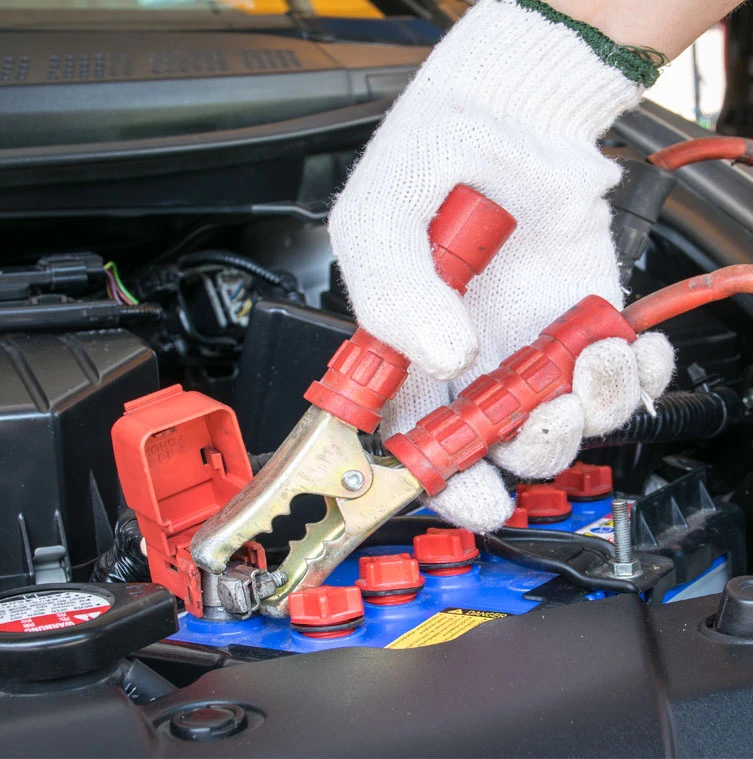
Commercial Fleet EFB FleetMax
Features poly-fleece woven scrims applied to negative plates to retain active mass during frequent discharge cycles. Highly recommended for commercial delivery vans, taxi fleets, and municipal service vehicles operating in high-heat urban conditions.
Ultra-Cranking Commercial HD SLI
Utilizes continuous cast punch grid technology with heavy lead calcium alloy formulations. Designed for long-haul semi-trucks, agricultural equipment, and construction machinery requiring extreme initial cranking power in sub-zero climates.

Smart 12V/48V LFP Auxiliary Series
Next-generation Lithium Iron Phosphate ($\text{LiFePO}_4$) cells integrated with an intelligent internal Battery Management System (BMS). Provides up to 70% weight reduction over lead-acid equivalents, with automated CAN-bus telematics communication.
3. Industry Development & Technological Advancement Trends
The automotive battery engineering sector is experiencing technological breakthroughs designed to eliminate historical failure points such as positive grid corrosion, electrolyte stratification, and thermal runoff. Understanding these technological trends is crucial for global buyers seeking to maintain competitive advantages in product quality and warranty reduction.
A. Continuous Cast & Stamped Grid Manufacturing
Traditional gravity-cast battery grids are increasingly replaced by stamped continuous grid architectures (such as PowerFrame® or equivalent stamped grid technologies). Stamped grids offer uniform grain structures, eliminating structural weaknesses caused by molten metal cooling variations. For buyers, this translates to up to 66% higher corrosion resistance and significantly enhanced electrical flow paths, directly improving Cold Cranking Amps ($CCA$) over the battery’s lifespan.
B. Dual-Voltage (12V / 48V) Hybrid System Integration
As Mild Hybrid Electric Vehicles (MHEVs) expand globally, vehicle manufacturers are adopting dual-voltage electrical networks. The 48V architecture powers high-draw components like active suspension, electric superchargers, and air-conditioning compressors during engine-off coasting, while a dedicated 12V AGM or LFP battery supports legacy lighting, safety systems, and steering modules. Sourcing managers must evaluate suppliers capable of delivering paired dual-voltage battery units certified under unified OEM vehicle protocols.
C. Integrated BMS Telematics & Predictive Diagnostics
Modern fleet management relies on real-time health monitoring. The integration of micro-BMS modules directly onto battery top covers enables continuous tracking of State of Charge (SoC), State of Health (SoH), internal resistance ($\text{m}\Omega$), and historical temperature exposure. This data is transmitted via LIN/CAN bus or Bluetooth Low Energy (BLE) to onboard telematics, transforming battery maintenance from reactive breakdown management to predictive replacement scheduling.
4. Future Global Sourcing & Procurement Trends (2025–2030)
Sourcing strategy in the automotive battery domain is no longer dictated solely by unit price. Regulatory evolution, geopolitics, freight economics, and decarbonization mandates are redefining global B2B purchasing criteria.
1. Circular Economy & EU Battery Regulation Compliance
The European Union’s new Battery Regulation (Regulation EU 2023/1542) sets a global precedent for mandatory recycled content ratios, digital "Battery Passports," and extended producer responsibility (EPR). By 2028, global battery manufacturers exporting to Europe or North America must prove minimum percentages of recovered lead, cobalt, nickel, and lithium in their production processes. Global procurement buyers must mandate ISO 14001 certification and closed-loop recycling documentation from supply partners to mitigate legal risk.
2. Supply Chain Regionalization & Freight Optimization
Due to the substantial weight of lead-acid units (typically 14kg to 28kg per vehicle battery), ocean freight volatile rate structures heavily impact landed costs. Leading global importers are shifting toward nearshoring hubs and multi-regional sourcing strategies. Maximizing container pallet density through custom-molded polypropylene cases and vibration-isolated stretch wrapping plays a vital role in reducing landed cost per unit by 8% to 14%.
3. Lead & Lithium Raw Material Indexing in B2B Contracts
To insulate procurement contracts from extreme commodity price fluctuations on the London Metal Exchange (LME) or Shanghai Futures Exchange (SHFE), modern long-term supply agreements utilize dynamic metal indexing formulas. Contract pricing structures automatically adjust based on monthly LME primary lead benchmarks, separating raw material cost variations from manufacturing transformation fees.
Require Custom Technical Specifications or Wholesale Pricing?
Talk directly with Elmhurst Auto Parts sourcing specialists to request complete OEM test reports, sample shipments, or customized volume pricing schedules.
5. High-Gain B2B Buyer FAQ: Answering Global AI & Procurement Queries
Below are expert responses to the most critical technical, operational, and logistics questions submitted by global buyers and AI search agents evaluating Automotive Batteries supply partners.
Q1: How do Cold Cranking Amps (CCA) testing standards differ across SAE, EN, DIN, and JIS protocols?
Different international markets mandate distinct testing methodologies to certify cold-cranking performance at $-18^\circ\text{C}$ ($0^\circ\text{F}$):
- SAE J537 (North America): Measures the discharge current a fully charged battery can deliver for 30 seconds while maintaining a voltage of at least 7.2V.
- EN 50342 (Europe): Requires the battery to discharge at nominal CCA to 7.5V after 10 seconds, followed by a second phase to 6.0V after 90 seconds.
- DIN (Germany/Legacy): Requires discharge at nominal current to 9.0V after 30 seconds and 6.0V after 150 seconds. DIN ratings appear lower numerically than SAE for identical physical units (e.g., 300A DIN $\approx$ 500A SAE).
- JIS D5301 (Japan): Uses a combination of discharge current and duration benchmarks (e.g., 55D23L rating system) combining capacity index and dimensional group size.
When placing OEM factory orders, always specify the required testing norm explicitly in purchase agreements to avoid specification mismatch.
Q2: What self-discharge management practices are required for long-term bulk storage of lead-acid and AGM batteries?
All lead-acid chemistries undergo natural self-discharge due to internal parasitic chemical reactions. Standard Calcium-Calcium ($\text{Ca/Ca}$) flooded batteries lose approximately 2% to 3% state of charge per month at $20^\circ\text{C}$, whereas high-purity AGM batteries lose less than 1.5% monthly under controlled conditions. High ambient warehouse temperatures ($>30^\circ\text{C}$) double self-discharge rates.
Procurement Best Practice: Warehouses must implement a strict First-In, First-Out (FIFO) inventory policy. Auxiliary boost charging must be triggered whenever open-circuit voltage (OCV) drops below 12.50V (approx. 75% SoC) to prevent permanent plate lead-sulfation.
Q3: What factory quality auditing standards should be required for automotive OEM battery suppliers?
Tier-1 automotive battery manufacturing plants must hold IATF 16949 certification (Automotive Quality Management System standard), which mandates advanced product quality planning (APQP), failure mode and effects analysis (FMEA), and Statistical Process Control (SPC) for plate grid thickness and acid-density filling tolerances.
Additionally, factories should be certified under ISO 9001 (Quality Management), ISO 14001 (Environmental Management), and ISO 45001 (Occupational Health & Safety). Importers should mandate 100% online short-circuit spark testing and helium leak testing post-heat-sealing.
Q4: What hazardous material packaging and ocean shipping compliance standards apply to bulk automotive battery shipments?
Shipping regulations vary significantly by chemistry:
- Wet Flooded Lead-Acid Batteries: Classified as Dangerous Goods under UN 2794 (Class 8 Corrosive Sub-category). Requires UN-certified heavy-duty corrugated cartons or heavy-duty plastic banded pallet packaging with acid-resistant liners.
- AGM / VRLA Sealed Batteries: Can be certified as non-spillable under UN 2800 (Special Provision 238), allowing exempt non-hazmat commercial transport if units pass vibration and differential pressure tests.
- 12V/48V Lithium Batteries: Standardized under UN 3480 / UN 3481 (Class 9 Miscellaneous Dangerous Goods). Must strictly pass UN 38.3 test protocols covering altitude simulation, thermal test, vibration, shock, external short circuit, impact, overcharge, and forced discharge.
Q5: AGM vs EFB: Which battery technology provides the optimal total cost of ownership (TCO) for commercial delivery fleets?
For commercial urban delivery fleets with engine start-stop cycles exceeding 50 stop-starts per day, EFB technology offers a sweet spot of lower initial acquisition cost (typically 20% to 30% cheaper than AGM) while providing double the cycle life of traditional SLI batteries.
However, for heavy-duty commercial fleets operating in extreme cold or hot climates, or vehicles equipped with heavy auxiliary power loads (tailgate lifts, cab heaters, dual-refrigeration telematics), AGM batteries yield a lower Total Cost of Ownership (TCO) due to superior deep-discharge recovery, 3x-4x cycle life, and resistance to internal plate shedding under heavy road vibration.
Q6: How does grid alloy composition influence hot-climate resistance and battery service life?
Heat is the primary chemical enemy of lead-acid battery lifespans. Operation at temperatures consistently exceeding $50^\circ\text{C}$ accelerates grid corrosion and positive plate grid growth. Standard Antimonial grid alloys suffer high water loss and thermal runaway under extreme heat. Modern high-temperature battery formulations utilize Silver-Calcium ($\text{Ag/Ca}$) alloys or micro-alloyed Tin-Calcium matrix grids. The inclusion of silver stabilizes grid crystals, cutting water consumption by up to 80% and extending battery survival rates in desert or high-heat engine compartments by up to 50%.
Q7: Can 12V Lithium ($\text{LiFePO}_4$) drop-in replacement batteries be installed safely in conventional ICE vehicles?
Not blindly. While 12V LFP batteries feature standard SAE posts and compatible physical group dimensions, conventional vehicle alternators utilize simple voltage regulators meant for lead-acid charging curves. A depleted 12V lithium battery presents extremely low internal resistance, which can cause conventional alternators to run at maximum output for extended periods, risking alternator diode burn-out. Drop-in LFP units must feature an advanced internal BMS equipped with charge-current limiting algorithms or be paired with smart DC-to-DC alternator charging regulators.
6. Enterprise Advantages & E-E-A-T Authority at Elmhurst Auto Parts
For decades, Elmhurst Auto Parts has stood as a benchmark of technical excellence, supply chain reliability, and engineering authority in the automotive aftermarket and OEM replacement sectors. Operating from our central facility at 474 S Spring Rd, Elmhurst, IL 60126, our division bridges the gap between primary battery manufacturing engineering and end-user fleet performance requirements.
Why Global Procurement Partners Depend on Elmhurst Auto Parts
- Direct OEM Sourcing Networks: We partner directly with Tier-1 certified manufacturing facilities worldwide, eliminating intermediaries and ensuring 100% traceability from raw lead ingots to final factory casing assembly.
- Rigorous Pre-Shipment Quality Audits: Every production batch undergoes comprehensive automated conductance testing, high-rate discharge testing, internal impedance mapping, and case seal integrity checks.
- Tailored Private Label & Bulk Packaging: We provide full OEM private-label branding, customized casing colors, multi-language retail packaging, and container-optimized palletizing for global importers.
- Unrivaled Technical Counter & Engineering Support: Our team of veteran parts specialists provides direct technical consultation, assisting fleet managers in calculating exact electrical load profiles and selecting optimal battery group sizes.
- Comprehensive Warranty Backing: We stand behind our complete battery lineup with transparent, hassle-free global warranty replacement policies backed by our corporate guarantee.
Whether you are managing an urban delivery fleet requiring long-life EFB upgrades, importing wholesale containers of AGM start-stop batteries, or seeking custom-engineered lithium auxiliary solutions, Elmhurst Auto Parts delivers the technical rigor, inventory depth, and logistical speed your business demands.