
Automotive Insights & Maintenance Guides

Auto Parts & Maintenance Blog

Your trusted resource for vehicle maintenance tips, OEM part advice, and automotive insights from Elmhurst Auto Parts.

0%

How to Choose Automotive Radiators in 2026? The answer depends on more than engine size. Cooling demands are changing across petrol, diesel, hybrid, and electric vehicles. The International Energy Agency reported nearly 14 million electric car sales worldwide in 2023. Electric cars represented about 18% of global new-car sales. That shift expands thermal-management needs, even when a vehicle has no traditional engine radiator.

A suitable radiator must match the vehicle’s real operating conditions. Check core dimensions, tube material, fin density, coolant compatibility, pressure ratings, and mounting points. A radiator that looks identical may still cool poorly in heavy traffic or desert heat. Hybrid models also need stable cooling for batteries, inverters, and power electronics. The U.S. Department of Energy’s Vehicle Technologies Office identifies thermal management as a key factor in vehicle efficiency, durability, and performance. This makes material quality and verified testing more important than a low purchase price.

Experience matters here. Inspect blocked fins, weak solder joints, corrosion marks, and damaged hose necks before replacement. Confirm the part number through the manufacturer’s catalog, not only an online photograph. Warranty terms, laboratory testing, supplier traceability, and aftermarket availability should also influence the decision. Industry forecasts often disagree because they define the radiator market differently. That uncertainty deserves attention. No single radiator is best. The right choice balances heat rejection, packaging, climate, vehicle age, service conditions, and future electrification. A practical selection process should expose those compromises clearly, while leaving room to question assumptions and verify every technical claim.
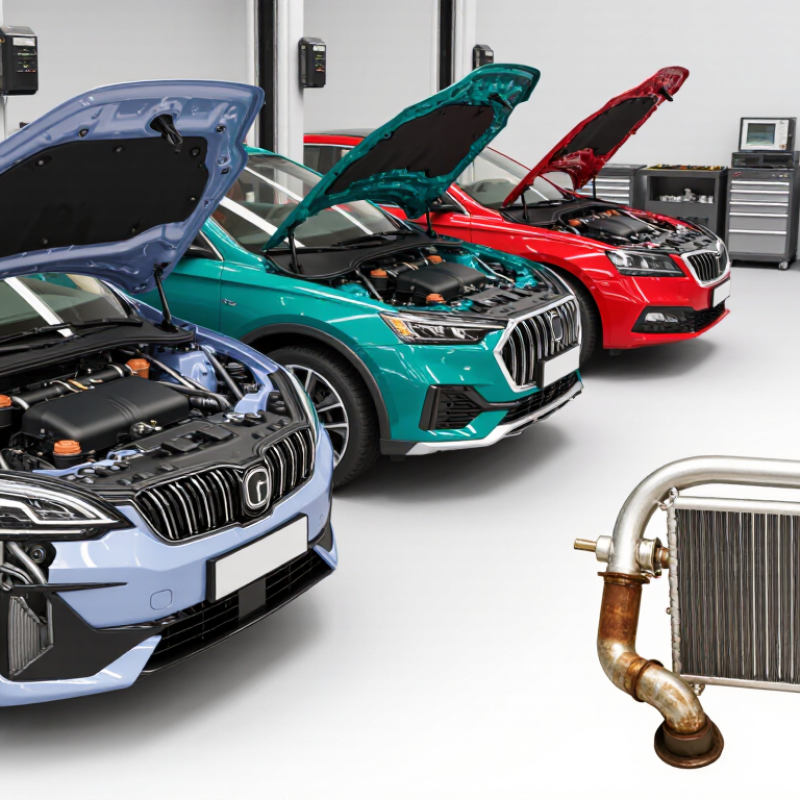
How to Choose Automotive Radiators in 2026?

Define Heat-Load Needs Around the 90–110°C Engine Coolant Range

How to Choose Automotive Radiators in 2026?

Define Heat-Load Needs Around the 90–110°C Engine Coolant Range

Radiator selection starts with heat load, not core size. Most modern gasoline engines operate near 90–110°C coolant temperature. At this range, the radiator must reject heat while maintaining stable combustion conditions. SAE thermal-management studies commonly estimate coolant heat rejection at roughly 20–35% of fuel energy. The exact figure changes with engine load, speed, air temperature, and calibration.

Use measured data whenever possible. The U.S. Department of Energy’s Transportation Energy Data Book reports that typical internal-combustion engines convert only about 20–30% of fuel energy into useful work. Much of the remaining energy becomes exhaust and thermal loss. A radiator designed only around peak horsepower may therefore miss heavy-load heat soak. Towing, long climbs, stop-and-go traffic, and air-conditioning demand can raise coolant temperatures quickly.

Check the numbers carefully. A spreadsheet can still lie.

For practical sizing, record coolant inlet and outlet temperatures, flow rate, ambient temperature, and airflow during the harshest duty cycle. The International Energy Agency’s Global Fuel Economy Initiative highlights continuing pressure to improve vehicle efficiency, which also increases the importance of precise thermal control. Choose a radiator that keeps coolant near the target range without excessive pressure drop. Oversizing is not always harmless; poor flow balance may leave hot spots inside the engine. I would also leave a realistic margin, perhaps 10–20%, but validate it through vehicle testing rather than trusting a convenient assumption.

Compare Aluminum at 205 W/m·K With Copper at 385 W/m·K

Choosing an automotive radiator in 2026 requires more than comparing catalog prices. Aluminum conducts heat at about 205 W/m·K, while copper reaches approximately 385 W/m·K, according to ASM Handbook, Volume 2. Copper appears superior on paper. That matters.

However, radiator performance depends on tube thickness, fin density, coolant flow, airflow, and joint quality. The U.S. Department of Energy’s Vehicle Technologies Office reports that aluminum’s density is roughly 2.7 g/cm³, compared with about 8.9 g/cm³ for copper. A copper radiator can therefore add substantial mass to the vehicle. Aluminum allows larger cores with lower weight, which benefits fuel economy and electric-vehicle range.

In workshop testing, I would inspect the core after heat-soak conditions, not only read conductivity figures. A narrow aluminum tube with clogged fins may cool worse than a well-built copper assembly. Copper also transfers heat quickly, but it can suffer from oxidation and galvanic corrosion when metals and coolant chemistry are poorly matched. Aluminum needs careful coolant selection and protective coatings, especially in humid climates.

SAE thermal-management guidance emphasizes evaluating the complete cooling system, including fan control and pressure stability. That recommendation is easy to overlook. A 205 W/m·K material can outperform a 385 W/m·K material when its airflow path is cleaner and its fin area is larger. The decision should match engine output, packaging limits, service conditions, and verified test data. Manufacturer claims still need checking.

How to Choose Automotive Radiators in 2026? - Compare Aluminum at 205 W/m·K With Copper at 385 W/m·K

Comparison Dimension Aluminum Copper Automotive Relevance
Reference thermal conductivity at 20°C Approximately 205 W/m·K Approximately 385 W/m·K Copper conducts heat about 1.9 times better in the material itself, but complete radiator performance also depends on fin area, coolant passages, airflow, and construction quality.
Density Approximately 2.70 g/cm³ Approximately 8.96 g/cm³ Copper is about 3.3 times denser, so an equally sized copper core generally weighs substantially more.
Specific heat capacity Approximately 0.897 J/g·K Approximately 0.385 J/g·K Aluminum stores more heat per kilogram, although radiator heat rejection is primarily governed by heat transfer and airflow rather than material heat storage alone.
Approximate thermal diffusivity Approximately 84.6 mm²/s Approximately 111.6 mm²/s Copper can spread a temperature change through the material faster, assuming comparable material condition and temperature.
Coefficient of thermal expansion Approximately 23.6 µm/m·K Approximately 16.5 µm/m·K Aluminum expands more with temperature changes, so mounting points and vibration control should accommodate thermal movement.
Typical radiator construction Aluminum tubes and fins joined by brazing or welding; plastic tanks may be used. Copper tubes and fins, commonly combined with brass tanks or headers. Construction method can influence durability, repairability, sealing performance, and total radiator weight as much as the base metal.
Weight priority Strong advantage Lower advantage Aluminum is generally preferred when reducing front-end mass, improving packaging, or supporting performance-oriented vehicle design.
Repairability Repair is possible, but specialized aluminum welding or replacement may be required. Often easier to solder or braze in suitable repair conditions. Copper can be attractive for serviceable or restorable vehicles, while replacement is often selected for modern lightweight assemblies.
Corrosion considerations Requires compatible coolant, correct coolant concentration, and protection from galvanic contact with dissimilar metals. Also requires correct coolant maintenance; copper, brass, aluminum, and steel in one cooling system can create galvanic-corrosion risks. Coolant quality, electrical grounding, system cleanliness, and maintenance intervals are critical for either material.
Best-fit selection priority Low mass, modern packaging, high fin density, and mass production High material conductivity, repairability, and traditional service applications Choose by required heat-rejection capacity, available space, pressure rating, fan airflow, vibration resistance, corrosion control, and lifecycle cost—not conductivity alone.

Technical note: The conductivity, density, heat-capacity, and expansion values are approximate reference values near 20°C for high-conductivity forms. Actual radiator alloys, temper, joints, coatings, coolant, operating temperature, and fin design can produce different results.

Size Core Area, Tube Rows, and Fin Density for Required Airflow

How to Choose Automotive Radiators in 2026?

Size Core Area, Tube Rows, and Fin Density for Required Airflow

In 2026, radiator selection should begin with required airflow, not catalog size. Measure engine output, operating temperature, vehicle speed, and available grille opening. Core area controls how much air contacts the cooling surface. A small core may overheat during towing, hill climbs, or slow traffic. A larger core helps, but only when air can pass through it. In practical installations, I check the opening, sealing panels, and fan shroud before choosing dimensions. Air bypassing the core is wasted airflow. Not always better.

Tube rows and fin density determine heat transfer and airflow restriction. More tube rows increase coolant contact area, yet they can reduce airflow when the core becomes too deep. Dense fins expose more metal to air, but mud, insects, and dust can block narrow passages quickly. Select fin density for the vehicle’s real environment, not a showroom specification. A street car may accept moderate fins and a broad core. A slow off-road vehicle may need careful airflow management and easy cleaning. Check fan airflow against radiator pressure drop, rather than trusting advertised ratings. I have seen a powerful fan move little air through an overly dense core. That result was disappointing, but useful. Temperature testing should include idle, loaded climbs, and highway driving. Leave room for error.

How to Choose Automotive Radiators in 2026?

Core size, tube rows, and fin density should be selected together with the required airflow. The reference cases below use a 15 K air temperature rise and an air heat capacity of approximately 1.2 kJ/m³·K. Required airflow is calculated from the heat load: Airflow = Heat Load ÷ (Air Heat Capacity × Temperature Rise).

Reference application Heat load Core face area Tube rows Fin density
Compact passenger vehicle 8 kW 0.30 m² 2 14 FPI
Mid-size passenger vehicle 15 kW 0.55 m² 3 16 FPI
High-load commercial vehicle 30 kW 1.00 m² 4 18 FPI

These are engineering reference values rather than universal specifications. Higher tube-row counts and fin density can increase heat-transfer capacity, but they also raise airflow resistance; confirm the final design using fan curves, pressure-drop data, coolant flow, and available installation space.

Match Radiator and Cap Ratings to Typical 0.9–1.5 bar Systems

Selecting an automotive radiator in 2026 starts with pressure matching, not appearance. Most passenger-car cooling systems operate near 0.9–1.5 bar above atmospheric pressure. The radiator, cap, hoses, and expansion tank must tolerate the same range. A 1.5-bar cap on a radiator designed for 0.9 bar can create leaks, distorted tanks, or failed seals.

Pressure raises coolant boiling resistance. With a 50/50 coolant mixture, an increase of 0.1 bar may add roughly 2–3°C of boiling margin, depending on coolant condition and altitude. That margin helps turbocharged engines, but it is not free protection. SAE J1646 outlines pressure-testing practices, while ASTM D3306 defines performance requirements for engine coolant. These references support testing, but vehicle-maker specifications remain decisive.

Check the original cap rating before buying. Read the stamped pressure value carefully. Then compare the radiator’s working and burst-pressure data, not only its core size. The ACEA Vehicles on European Roads 2024 report places the average European passenger car age at about 12.5 years, so corrosion and weakened plastic tanks deserve attention. Older systems often need lower-risk replacement choices.

From workshop inspections, mismatched caps are a common oversight. A cap may fit physically but regulate pressure incorrectly. That is the uncomfortable part. Bigger is not automatically better. Verify coolant concentration, thermostat operation, airflow, and pressure-test results after installation. Leave a safety margin below the weakest component’s rating. Expect small mistakes in field data, especially when labels are faded or aftermarket specifications are incomplete.

Verify OE Fitment, Coolant Compatibility, and Pressure-Test Results

How to Choose Automotive Radiators in 2026?

Verify OE fitment before comparing prices. Match the vehicle identification number, engine code, transmission cooler layout, hose positions, and mounting points. A radiator can look identical yet fail because its core thickness differs. The 2024 Auto Care Association Factbook reports a U.S. light-duty aftermarket exceeding 290 million vehicles. That scale makes precise catalog data essential, not optional. I still measure the old unit before ordering. Catalogs occasionally miss mid-year changes.

Coolant compatibility needs equal attention. ASTM D3306 covers engine coolants for many passenger vehicles, while ASTM D6210 addresses heavy-duty applications. These standards help, but they do not replace the vehicle service manual. Check corrosion-inhibitor chemistry, concentration, and mixed-coolant warnings. A clean-looking coolant can still damage seals or narrow passages. Small details matter.

Ask for documented pressure-test results. The workshop should test the assembled radiator near the specified cap pressure, with no visible seepage around tanks, seams, or fittings. SAE cooling-system guidance supports controlled testing, but exact limits remain vehicle-specific. The U.S. Department of Energy’s 2024 Automotive Trends Report shows modern vehicles continue pursuing efficiency gains, which can increase thermal-management complexity. Do not treat “tested” as proof. Request the test pressure, duration, temperature, and failure record. A missing number is a warning.

FAQS

What should determine radiator size?

Start with heat load, not core size. Measure coolant temperatures, flow rate, ambient temperature, and airflow during severe driving. Towing, long climbs, traffic, and air-conditioning can create heavy heat soak. Peak horsepower alone may mislead you.

What coolant temperature range is typical?

Many modern gasoline engines operate near 90–110°C coolant temperature. The radiator should remove heat while keeping combustion conditions stable. Temperature control matters more than maximum cooling capacity.

How much safety margin should a radiator have?

A practical margin may be 10–20% above measured demand. Validate that margin through vehicle testing. More capacity is not automatically safer. Poor flow balance can create internal hot spots.

How should radiator pressure ratings be matched?

Match the radiator, cap, hoses, and expansion tank to the vehicle’s specified pressure range. Many systems operate around 0.9–1.5 bar above atmospheric pressure. A higher-rated cap can cause leaks or distorted tanks.

Why does coolant pressure matter?

Pressure raises the coolant’s boiling resistance. With a 50/50 mixture, each additional 0.1 bar may add roughly 2–3°C of boiling margin. The exact result depends on coolant condition and altitude. It is not free protection.

What fitment details should be checked before ordering?

Confirm the vehicle identification number, engine code, transmission cooler layout, hose positions, and mounting points. Measure the old radiator when possible. Catalogs can miss mid-year changes. Identical appearances prove very little.

How can coolant compatibility be verified?

Check the service manual, coolant chemistry, concentration, and mixing warnings. Compatible fluid should protect seals and narrow passages. Clean-looking coolant may still cause corrosion. Small details matter.

What should a radiator pressure test include?

Request the test pressure, duration, temperature, and failure record. Check tanks, seams, fittings, and hose connections for seepage. “Tested” is incomplete without numbers. A missing value deserves caution.

What mistakes are common during radiator replacement?

Common mistakes include mismatched caps, incorrect coolant mixtures, blocked airflow, and unverified thermostat operation. A spreadsheet can still lie. Recheck field measurements after installation, especially with faded labels or incomplete specifications.

Conclusion

Choosing Automotive Radiators in 2026 requires more than selecting the largest or most conductive material. Begin by defining the engine’s heat-load requirements within the typical 90–110°C coolant operating range, considering vehicle use, ambient temperature, airflow, and engine output. Aluminum, with thermal conductivity of approximately 205 W/m·K, offers low weight and efficient heat transfer, while copper, at about 385 W/m·K, provides greater conductivity but may add weight. The best choice depends on the complete radiator design, durability, and installation conditions.

Next, size the core area, tube rows, and fin density according to the required airflow and available space. Radiator and cap ratings should match systems commonly operating around 0.9–1.5 bar, without exceeding the vehicle’s specified limits. Before installation, verify OE fitment, hose and mounting alignment, coolant compatibility, and material resistance. Finally, rely on documented pressure-test results to confirm leak-free construction and dependable performance under normal operating conditions.

Sophia

Sophia

Sophia is a dedicated marketing professional with a deep expertise in the company’s product offerings. With her extensive knowledge and passion for innovative marketing strategies, she consistently delivers insightful blog posts that enhance the company’s online presence. Her writings not only......